Agrimony
Agrimony
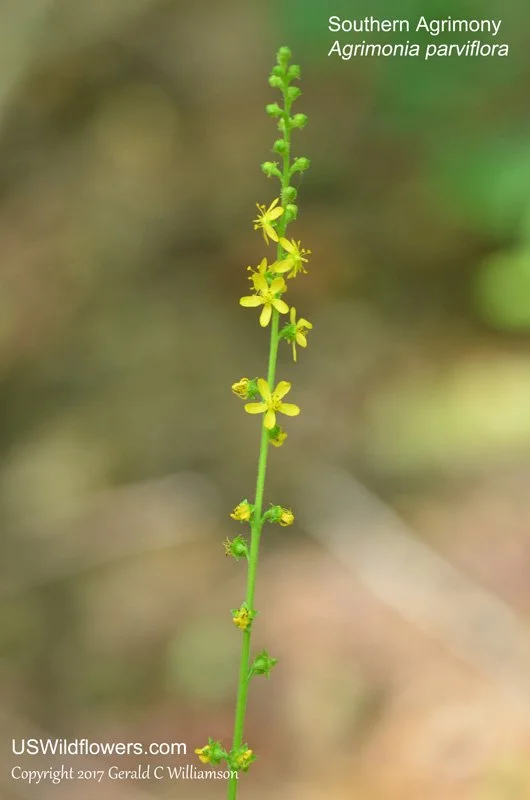
Agrimonia eupatoria
Family
Rosaceae (Rose Family)
Common Names
Church Steeples
Sticklewort
Cockleburr
Philanthropos
Parts Used
Aerial portions (leaves, stems, flowers)
Occasionally the root
Botanical Description
Agrimony is a perennial herb native to Europe and naturalized throughout parts of North America. It produces tall spikes of small yellow flowers that bloom from midsummer into early autumn. The plant is often found along roadsides, meadows, woodland edges, and disturbed ground.
Traditional Medicinal Uses
Agrimony has a long history of use in traditional Western herbalism. Historically, herbalists employed it as an astringent herb for supporting digestive wellness, soothing the throat, and promoting general tissue tone.
Traditional uses include:
Occasional digestive discomfort
Mild diarrhea
Sore throat gargles
Minor skin irritations
Wound washes
General tonic preparations
Historically, agrimony was often prepared as a tea, gargle, poultice, or infused wash.
Herbal Preparations
Tea
The dried aerial portions may be steeped to create a mildly bitter herbal infusion.
Gargle
Traditional preparations were used as a gargle for temporary throat discomfort.
Poultice
Fresh or moistened dried herb was historically applied externally.
Tincture
Used by modern herbalists as a concentrated preparation.
Habitat & Distribution
Agrimony grows in temperate regions across Europe, western Asia, and North Africa, and has become naturalized in many parts of North America. It thrives in sunny to partially shaded locations and is commonly found in meadows, pastures, hedgerows, woodland margins, roadsides, and other open areas with well-drained soil.
Cultivation Techniques
Agrimony is generally easy to cultivate and adapts well to a variety of garden settings.
Growing Conditions
Prefers full sun to partial shade
Thrives in well-drained soil
Tolerates average garden soils once established
Benefits from moderate moisture but is relatively drought tolerant
Propagation
Seed
Seeds may be sown directly outdoors in autumn or early spring. Germination can be improved by a period of cold stratification.
Division
Established plants may be divided in spring or autumn to create new plants.
Maintenance
Water regularly during establishment
Remove competing weeds around young plants
Cut back spent flower stalks if desired
Allow some flowers to mature for seed collection and wildlife value
Harvesting
The aerial portions are typically harvested while the plant is in bloom. Gather healthy stems, leaves, and flowers on a dry day and dry them in a well-ventilated area away from direct sunlight.
Folklore & Historical Lore
Agrimony appears in numerous European folk traditions. In medieval folklore, it was believed to offer protection from negative influences and was sometimes carried as a protective charm.
According to traditional lore, placing agrimony beneath a pillow encouraged deep sleep. Some stories claimed that individuals would not awaken until the herb was removed, though this should be understood as folklore rather than medicinal fact.
The herb was also associated with reversing harmful intentions and promoting reconciliation.
Magical Correspondences
Planet
Jupiter
Element
Air
Energetic Associations
Protection
Reversal of negativity
Sleep
Healing
Harmony
Boundary setting
Magical Uses
Protection sachets
Home blessing work
Sleep charms
Boundary and warding rituals
Healing spellcraft
Safety Notes
Agrimony has a long history of traditional use. Individuals who are pregnant, nursing, taking medications, or managing health conditions should consult a qualified healthcare professional before using herbal preparations.
This entry is intended for educational purposes and is not medical advice.
Field Notes
Space reserved for personal observations, harvest notes, photographs, habitat information, and experiences from Lobelia's Botanicals.
References
Herbalism Sources
Chevallier, Andrew. Encyclopedia of Herbal Medicine. DK Publishing.
Grieve, Maud. A Modern Herbal.
Hoffmann, David. Medical Herbalism: The Science and Practice of Herbal Medicine.
Wood, Matthew. The Earthwise Herbal.
Historical Sources
Culpeper, Nicholas. The Complete Herbal.
Grieve, Maud. A Modern Herbal.
Magical Sources
Cunningham, Scott. Cunningham's Encyclopedia of Magical Herbs.
Beyerl, Paul. The Master Book of Herbalism.