Aconite
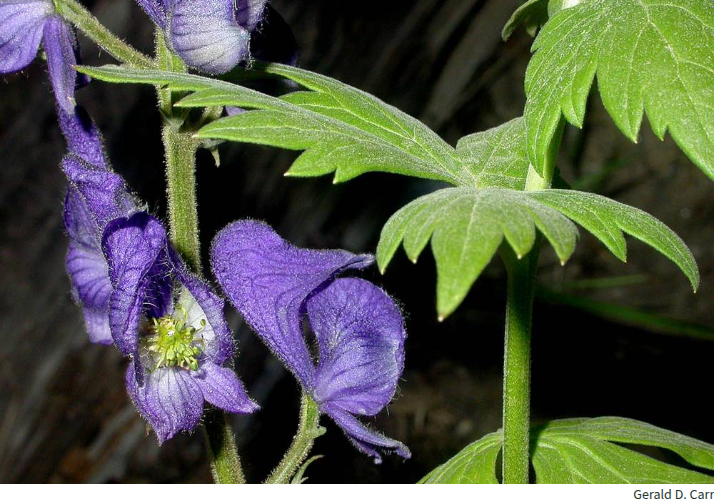
Photo sourced from https://oregonflora.org/taxa/index.php?taxon=2442
Aconitum napellus and related Aconitum species
Classification
⚠️ Highly Toxic Plant
Family
Ranunculaceae (Buttercup Family)
Common Names
- Monkshood
- Wolfsbane
- Blue Rocket
- Friar's Cap
- Queen of Poisons
Parts Used Historically
- Root
- Tuber
Note: All parts of the plant are considered poisonous.
Botanical Description
Aconite is a perennial flowering plant native to mountainous regions of Europe and Asia and cultivated in many temperate gardens throughout the world. It is known for its striking hood-shaped blue to purple flowers, from which the name "Monkshood" is derived.
Plants typically grow between 2–5 feet (0.6–1.5 m) tall and bloom from midsummer through autumn.
Warning
⚠️ Aconite is one of the most poisonous plants traditionally associated with European herbalism.
The plant contains potent alkaloids, including aconitine, which can affect the nervous and cardiovascular systems. Poisoning may occur through ingestion and, in some cases, prolonged skin contact with plant material.
This entry is provided for educational, historical, ethnobotanical, and folkloric purposes only.
Aconite should not be prepared or consumed based solely on information found online or in books.
Historical Medicinal Uses
Historically, aconite was employed in several traditional medical systems, including European, Chinese, and Himalayan practices.
Traditional uses included:
- Pain management
- Febrile illnesses
- Neuralgia
- Rheumatic complaints
Because of its extreme toxicity, its medicinal use declined significantly in many regions and is generally not recommended for self-treatment.
Ethnobotanical History
Throughout history, aconite was used not only as a medicine but also as a hunting and warfare poison.
Various cultures applied aconite extracts to:
- Hunting arrows
- Spear tips
- Wolf traps
The common name "Wolfsbane" originates from its historical use against wolves and other predators.
Folklore & Historical Lore
Aconite occupies a prominent place in European folklore.
Legends describe it as:
- A plant of protection against werewolves
- A ward against harmful spirits
- An herb associated with the underworld
- A plant linked to witches and sorcery
In Greek mythology, aconite was said to have sprung from the saliva of Cerberus, the three-headed hound guarding the entrance to the Underworld.
Because of these associations, aconite became one of the most famous plants in magical folklore.
Magical Correspondences
Planet
Saturn
Element
Water
Energetic Associations
- Protection
- Boundaries
- Spirit work
- Banishing
- Transformation
- Shadow work
Traditional Magical Uses
Historical magical traditions associated aconite with:
- Protective charms
- Spirit warding
- Boundary magic
- Banishing rites
Because the plant is highly toxic, modern practitioners often substitute symbolic representations rather than handling the plant itself.
Habitat & Cultivation
Aconite prefers:
- Cool climates
- Moist, well-drained soil
- Partial shade
It is commonly grown as an ornamental plant due to its striking flowers.
Gardeners should wear gloves when handling aconite and keep plants away from children and pets.
Field Notes
Space reserved for personal observations, photographs, habitat notes, cultivation experiences, folklore encounters, and regional observations.
References
Herbal & Historical Sources
Chevallier, Andrew. Encyclopedia of Herbal Medicine.
Grieve, Maud. A Modern Herbal.
Hoffmann, David. Medical Herbalism.
Toxicology & Botanical Sources
Cooper, M. R., and Johnson, A. W. Poisonous Plants and Fungi.
Royal Horticultural Society. Plant Profiles.
Folklore & Magical Sources
Cunningham, Scott. Cunningham's Encyclopedia of Magical Herbs.
Beyerl, Paul. The Master Book of Herbalism.
Mythological Sources
Classical Greek traditions concerning Cerberus and the origins of aconite.