Alder
Alnus spp.
Classification
🌲 Medicinal Tree
Family
Betulaceae (Birch Family)
Common Names
- Alder
- Red Alder (Alnus rubra)
- Black Alder (Alnus glutinosa)
- White Alder (Alnus rhombifolia)
- Common Alder
Parts Used
- Bark
- Leaves
- Catkins
- Cones
- Wood
Botanical Description
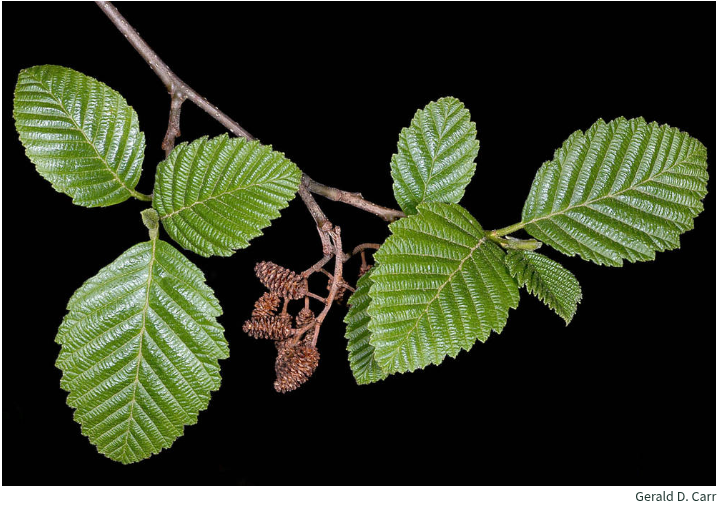
Alders are deciduous trees and shrubs found throughout the Northern Hemisphere. In the Pacific Northwest, Red Alder (Alnus rubra) is the most common species.
Alders are recognized by their:
- Serrated oval leaves
- Small woody cones
- Hanging catkins
- Smooth gray bark when young
They frequently grow near:
- Rivers
- Wetlands
- Streams
- Floodplains
- Moist forest edges
Alder is notable for its ability to improve soil fertility through a symbiotic relationship with nitrogen-fixing bacteria in its roots.
Traditional Medicinal Uses
Various alder species have been used by Indigenous peoples and traditional herbalists.
Traditional uses include:
- External washes
- Skin support
- Minor wound care
- Occasional digestive applications
- General cleansing preparations
The bark was most commonly utilized.
Herbal Preparations
Decoction
Bark was traditionally simmered to create a strong preparation.
Wash
Used externally for skin applications.
Poultice
Fresh leaves were occasionally applied externally.
Bath
Traditional preparations were sometimes added to bathing water.
Constituents
Notable constituents include:
- Tannins
- Flavonoids
- Phenolic compounds
- Astringent compounds
These contribute to alder's traditional use as an astringent plant.
Ethnobotanical History
Alder has a long history of use among Indigenous peoples of North America, Europe, and Asia.
In the Pacific Northwest, Red Alder was valued not only medicinally but also for:
- Dyes
- Woodworking
- Smoking foods
- Carving
- Ecological restoration
Because alder enriches soil, it often serves as a pioneer species following fire, floods, or logging disturbances.
Folklore & Historical Lore
Alder possesses rich folklore throughout Europe.
Traditional beliefs associated alder with:
- Protection
- Courage
- Resurrection
- Bridging worlds
- Sacred waters
Because alder thrives near rivers and wetlands, it often became associated with liminal places—those spaces that exist between one state and another.
In Celtic traditions, alder was sometimes linked to warriors and guardians.
Its wood famously turns reddish-orange when freshly cut, leading some cultures to believe the tree possessed living blood.
Magical Correspondences
Planet
Venus
Element
Water
Energetic Associations
- Protection
- Courage
- Healing
- Transformation
- Intuition
- Boundaries
Traditional Magical Uses
Historically associated with:
- River and water magic
- Protection charms
- Journey work
- Threshold rites
- Spirit communication
- Emotional healing
Habitat & Cultivation
Alders prefer:
- Moist soil
- Stream banks
- Wetlands
- Full sun to partial shade
They grow rapidly and play an important ecological role in restoring disturbed landscapes.
Wildlife Value
Alder supports numerous species of wildlife.
Benefits include:
- Pollinator support
- Bird habitat
- Seed production for songbirds
- Soil enrichment
- Stream stabilization
In the Pacific Northwest, alder contributes significantly to healthy riparian ecosystems.
Safety Notes
Traditional medicinal uses are documented throughout history; however, modern medicinal use is relatively limited compared to some other herbal species.
This entry is provided for educational purposes and is not medical advice.
Field Notes
A tree of rivers, rain, and renewal. Space reserved for personal observations, photographs, habitat notes, folklore encounters, and experiences from Lobelia's Botanicals.
References
Herbal Sources
Chevallier, Andrew. Encyclopedia of Herbal Medicine.
Grieve, Maud. A Modern Herbal.
Ethnobotanical Sources
Turner, Nancy J. Plants of the Pacific Northwest Coast.
Moerman, Daniel E. Native American Ethnobotany.
Folklore Sources
Pennick, Nigel. The Celtic Tree Oracle.
Green, Miranda. Dictionary of Celtic Myth and Legend.
Botanical Sources
U.S. Forest Service publications on Red Alder (Alnus rubra).
Oregon State University Extension resources.